

What If Closure Doesn't Exist?
Ambiguous loss, heartbreak, and healing.

“I don’t think you’re going to get closure,” I told her, softly. “I don’t think the answers you’re hoping for are coming.”
For a second I thought she might scream. But then the tears came.
And for the next 50 minutes of her therapy appointment, we let the fairytale of a clean ending dissolve between us.
The hardest part of heartbreak isn’t always the loss itself. Sometimes it’s the unbearable desire to know exactly what happened.
Was it real?
Did they love me?
Would it have worked if I had done something differently?
Often, we say we want closure, but what we really want is the person who broke the container to help us sweep up the glass. And we want them to tell us why they did it in the first place.
We want relief from ambiguity. We want the answer that finally lets our nervous systems soften, our nightmares stay away, our teeth to stop grinding.
And it makes sense. Humans are hardwired to want answers. To our nervous systems, to our fight-or-flight instincts, certainty keeps us safe. It has for thousands of years. We’re built to look for a definitive storyline. It helps us feel like we can plan for what’s next, and it helps us imagine we can stop ourselves from being hurt again in the future.
But waiting for an ex, or a deceased parent, or an estranged friend to give you closure is waiting for someone else to give you permission to stop hurting. Without meaning to, you outsource your healing. You tie your capacity to move forward to their willingness to explain themselves. You tie your body’s ability to sleep well at night to their ability to say the right words.
“Closure is not only a mythical, unobtainable goal, but also an especially unhealthy goal.”
- Pauline Boss, who coined the concept of ambiguous loss (which is grief without closure, including relationships changing due to estrangement, divorce, dementia, traumatic brain injuries, substance use, etc).
My job as a therapist has included thousands of hours of sitting in front of another person, reassuring them that there is life on the other side of heartbreak. My experience as a human has included many hours of convincing myself of the same thing.
When my own heart is broken, or when I’ve moved away from my dearest friends, or when I decide to set boundaries with someone I care about but can’t be around - I’ve felt the panic. The fear that comes with I don’t know what will happen next. The therapist part of me knows the clinical truth: closure isn’t coming. And I have to face a very human, very terrifying reality: grief comes with an unwanted masterclass in instability.
It’s painful. In fact, research has shown us that emotional pain is processed in the brain in the same way as physical pain. The feelings actually HURT. But feelings are survivable. They’re a sign that you’re human. Your body is working to keep you safe. Your body is trying to protect what is important to you.
Feelings are signals. They are information. These feelings tell us that change has happened, and we must change with it.
This is where grief and possibility are grown from the same wound.
Because in all the hurt, you still have to decide what to do next.
Even if it’s just for tomorrow morning. Tomorrow coming means you still need to sleep. You still need to eat breakfast and to walk the dog and keep building a life inside something unresolved. You don’t have to understand what happened to take care of yourself and to choose what comes next.
And this is the crucible: if you don’t hide from it, you are forced to learn a set of relational skills from the outside of the relationship that are just as important as the ones we use to stay in a relationship. You learn how to tolerate ambiguity. How to unclench your jaw in the face of uncertainty. How to navigate a world that changed even when you didn’t want it to.
Living with unanswered questions isn’t a failure to heal. It’s actually an incredible act of relational capacity.
The therapeutic field has moved away from helping people try to find closure, and more toward helping people learn to live with grief. Many people don’t know this, and are still looking for an endpoint that we stopped prescribing decades ago.
My favorite way to reframe how we look at grief is through Lois Tonkin’s model. It says that grief doesn’t shrink, but life continues to grow around it.
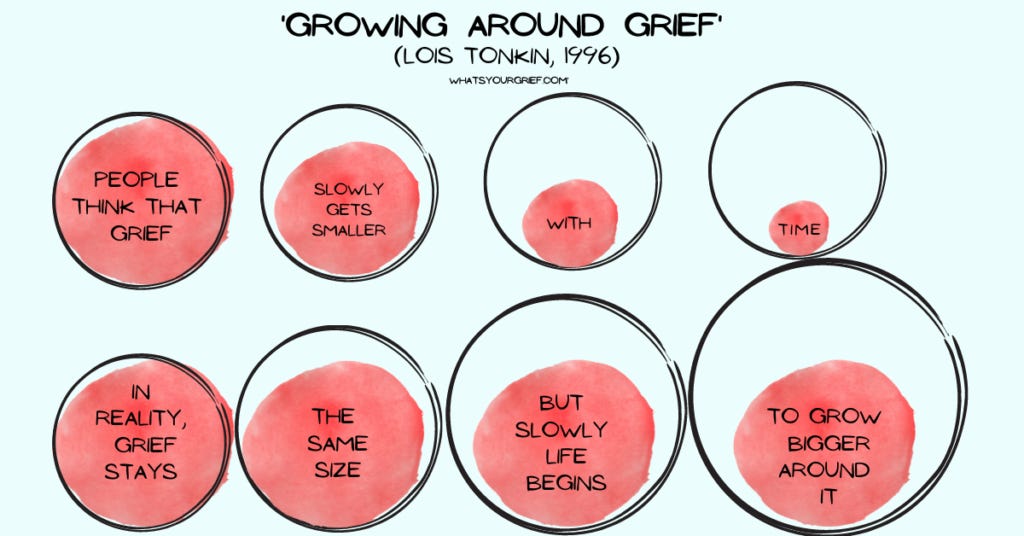
What if closure doesn’t exist? And if it does, what if it’s not the point? Maybe the point is to stop waiting for certainty before allowing ourselves to move forward.
We ARE capable of surviving uncertainty. We do it constantly.
Every relationship we enter into is, in some way, an agreement to enter into uncertainty.
And yet we live in a culture obsessed with resolution: with finding the end to the grieving process, finishing the healing journey, learning the lesson, moving on. But most of our human experiences (grief, love, estrangement, longing) don’t resolve that cleanly.
Closure looks for that resolution: over or not over; healed or broken; gone, or significant. But ambiguous grief demands not either/or, but both/and. Two things can be true at once. We can be both grieving and moving forward. A person can be both gone and still present. You can be permanently altered by a loss, and you can still build a massive, beautiful life around it. You can be sad and still hope.
And hope can be more than a feeling. It can be a plan.
A plan to not wait for the grief to shrink, but to start building a bigger container.
What a thought-provoking perspective. This hit me on a few cylinders.
Especially:“we want the person who broke the container to help us sweep up the glass.”
Oof.
There’s something strangely comforting about hearing someone say maybe closure isn’t the goal at all. Maybe learning to live, love, grieve, and still keep building a life inside the uncertainty is the work.
This was a bittersweet read with parts that will stick with me. Thank you.
The idea that we're waiting for the person who broke the container to help sweep up the glass is such a good way of describing it. I think a lot of people get stuck believing they need one final conversation before they can move forward, when sometimes that conversation never comes. What I've learned is that unanswered questions can take up less space over time even when they never get answered. Life keeps growing around them.